Nanotherapeutics in Cancer
Note: This page is educational and reflects public evidence last checked on 2026-05-22. Nanomedicine is not one therapy class; it is a toolbox of formulations, materials, devices, and delivery systems.
TL;DR
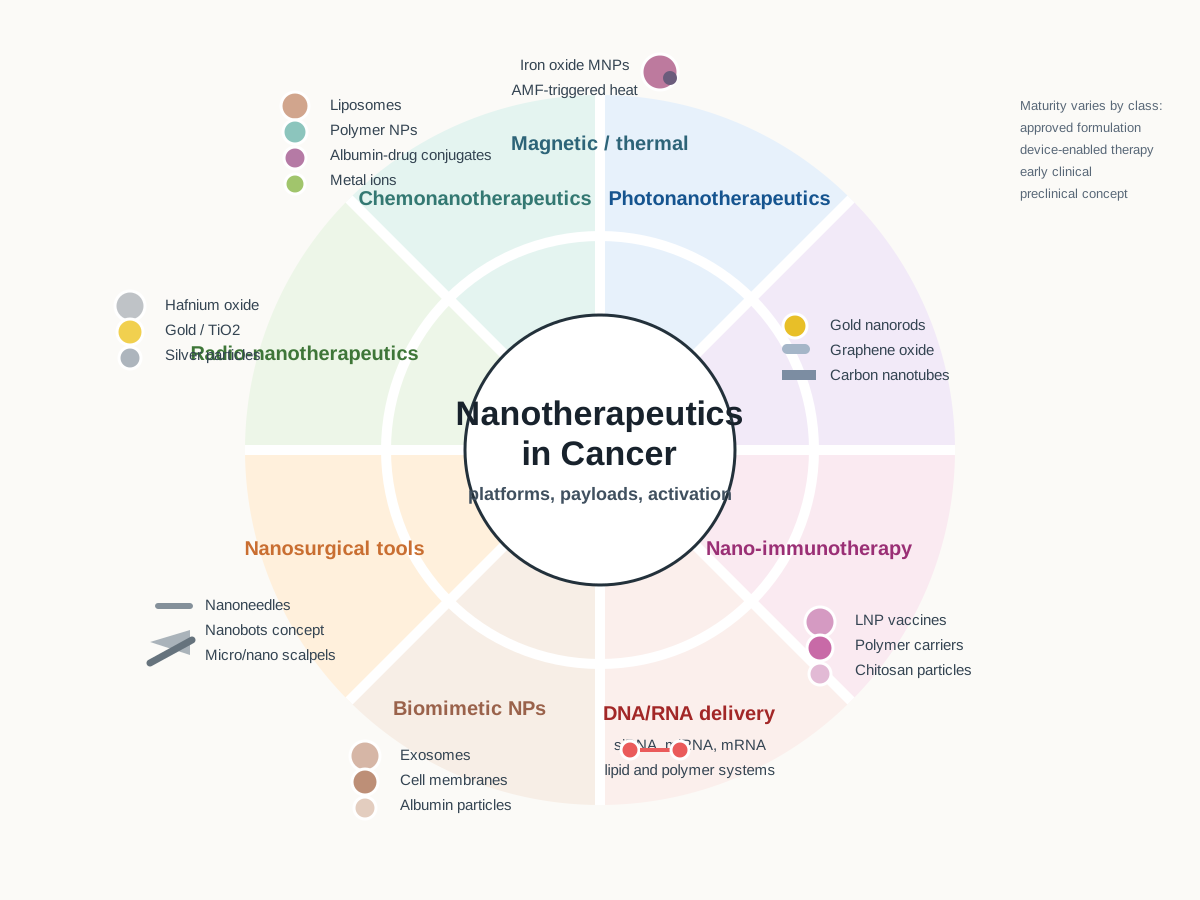
Cancer nanotherapeutics use nanoscale materials to change how drugs, genes, radiation, light, heat, or immune signals interact with tumors. Some are already routine, such as pegylated liposomal doxorubicin, albumin-bound paclitaxel, and liposomal irinotecan in selected indications. Others are device-like or investigational, such as hafnium oxide radioenhancers, photothermal particles, engineered RNA carriers, biomimetic vesicles, and nanosurgical concepts. The right question is not "does nano cure cancer?" It is: what payload, what material, what trigger, what tumor, what clinical endpoint, and what toxicity tradeoff?Sources: [1], [2], [3], [4]
1. A practical taxonomy
| Class | Typical platforms | Main job | Maturity |
|---|---|---|---|
| Chemonanotherapeutics | liposomes, albumin particles, polymeric NPs | change pharmacokinetics and toxicity of cytotoxic drugs | Approved products exist |
| Drug/gene delivery | lipid NPs, polymers, liposomes, conjugates | deliver siRNA, mRNA, miRNA, DNA, proteins, small molecules | Approved outside oncology; oncology active |
| Radio-nanotherapeutics | hafnium oxide, gold, gadolinium, high-Z particles | amplify radiation dose locally or add imaging | Clinical-stage; product status varies by jurisdiction |
| Photonanotherapeutics | gold nanorods, carbon materials, photosensitizer carriers | photothermal, photodynamic, or combined light activation | Mostly trials/preclinical |
| Nano-immunotherapy | LNP vaccines, polymeric adjuvants, antigen carriers | alter antigen delivery, adjuvancy, or immune localization | Active translational field |
| Magnetic/thermal | iron oxide magnetic nanoparticles | heat tumor under alternating magnetic field | Limited clinical experience |
| Biomimetic NPs | exosomes, cell-membrane coated NPs, albumin | evade clearance or mimic biology | Early translational |
| Nanosurgical tools | nanoneedles, nanocoatings, micro/nanorobots | local physical intervention | Mostly preclinical/conceptual |
The same material can appear in multiple classes. Gold nanoparticles, for example, can be used for photothermal therapy, radiosensitization, imaging, or drug delivery.
2. What is already clinically real
The clinically established part of oncology nanomedicine is narrower than the word "nano" suggests. Treat FDA or EMA labels as the source of truth for approved indications, dose, contraindications, warnings, and required monitoring.
| Platform | Example | Evidence status |
|---|---|---|
| Pegylated liposomal anthracycline | Doxorubicin hydrochloride liposome injection / DOXIL-class products | Approved drug labels exist; use only by labeled or guideline-supported indication |
| Albumin-bound taxane | Nab-paclitaxel / ABRAXANE | Approved drug labels exist; not universal tumor targeting |
| Liposomal topoisomerase inhibitor | Irinotecan liposome / ONIVYDE | Approved drug labels exist for defined pancreatic cancer settings |
| Hafnium oxide radioenhancer | NBTXR3 / Hensify-class product | Trial and jurisdiction-specific device/product status; verify locally before claiming availability |
Liposomal chemotherapy
Liposomal formulations can alter distribution, prolong circulation, reduce peak exposure, and change toxicity. Pegylated liposomal doxorubicin is used in ovarian cancer and other settings; liposomal irinotecan plus 5-FU/leucovorin improved outcomes in metastatic pancreatic cancer after gemcitabine-based therapy. Sources: [1], [2]
Albumin-bound paclitaxel
Nab-paclitaxel avoids Cremophor/ethanol solvent and changes infusion and toxicity logistics. It is not magic targeting; it is a clinically useful formulation with disease-specific evidence. Sources: [3]
Radioenhancing nanoparticles
NBTXR3 is a hafnium oxide nanoparticle injected into tumors and activated by radiotherapy. A randomized phase 2/3 soft-tissue sarcoma trial showed improved pathological complete response compared with radiotherapy alone, illustrating the device-drug boundary of nanomedicine. Sources: [4]
3. Why translation is hard
Nanomedicine often fails because elegant particle behavior in vitro does not survive the patient:
- protein corona changes surface identity
- mononuclear phagocyte clearance
- liver and spleen uptake
- heterogeneous tumor vasculature
- high interstitial pressure
- variable lymphatic drainage
- poor penetration beyond perivascular zones
- batch-to-batch manufacturing constraints
- sterilization and storage effects
- long-term biodistribution concerns
The EPR effect is real in some contexts, but it is not a universal delivery guarantee.
4. What each platform can and cannot solve
| Platform | Can improve | Cannot guarantee |
|---|---|---|
| Liposomes | circulation time, solubility, dose scheduling, some toxicity profiles | tumor specificity by default |
| Albumin particles | solvent-free delivery, pharmacokinetics | universal superiority over standard taxanes |
| LNPs | nucleic-acid delivery | selective tumor delivery without targeting logic |
| Gold/carbon materials | optical absorption, photothermal conversion | deep-tissue activation without light-delivery constraints |
| High-Z particles | local radiation enhancement | benefit without correct injection and RT planning |
| Iron oxide MNPs | remote heating under AMF | uniform intratumoral temperature |
| Exosomes/biomimetic carriers | biological compatibility hypotheses | scalable, reproducible, safe manufacturing |
5. Data model for a nanotherapeutic
For a serious page, grant, trial, or tool, capture:
| Layer | Fields |
|---|---|
| Material | lipid, polymer, albumin, iron oxide, gold, silica, hafnium, carbon, biomimetic |
| Size and shape | diameter, dispersity, charge, rod/sphere/shell/tube |
| Payload | drug, RNA, antigen, photosensitizer, heat, radiation enhancer |
| Trigger | passive, pH, enzyme, light, heat, magnetic field, radiation |
| Route | IV, intratumoral, surgical cavity, inhaled, topical |
| Endpoint | PK, tumor response, toxicity, imaging, immune activation, survival |
| Failure mode | clearance, off-target toxicity, poor penetration, immune reaction, manufacturing |
6. What technologists can build
- Formulation registries linking material properties to pharmacokinetics and toxicity.
- Image-analysis tools for nanoparticle distribution, thermal maps, PET/SPECT/MRI, and histology.
- Treatment-planning integrations for radioenhancers, phototherapy, and magnetic hyperthermia.
- Manufacturing QC dashboards for size distribution, charge, sterility, endotoxin, payload loading, and release.
- Trial matching for nanomedicine studies using route, tumor accessibility, payload, and prior therapy.
- Knowledge graphs connecting material, payload, target, trigger, disease, and clinical maturity.
7. Brazilian context
Brazil has strong materials science, chemistry, engineering, pharmacy, imaging, and oncology communities. The most realistic high-impact paths are: formulation analytics, image-guided delivery, local manufacturing know-how, radiotherapy-enabled nanoparticles, and careful clinical translation in accessible tumor settings. The weakest path is selling "nano" as a buzzword without pharmacology, toxicology, and endpoints.
See also
- Nanotechnology drug delivery
- Photodynamic therapy advances
- Magnetic hyperthermia
- BNCT
- AI-driven drug discovery
References
- Chen J, Hu S, Sun M, et al. Recent advances and clinical translation of liposomal delivery systems in cancer therapy. Eur J Pharm Sci 2024;193:106688. PMID 38171420. https://doi.org/10.1016/j.ejps.2023.106688
- Wang-Gillam A, Hubner RA, Siveke JT, et al. NAPOLI-1 phase 3 study of liposomal irinotecan in metastatic pancreatic cancer: Final overall survival analysis and characteristics of long-term survivors. Eur J Cancer 2019;108:78-87. PMID 30654298. https://doi.org/10.1016/j.ejca.2018.12.007
- Gradishar WJ, Tjulandin S, Davidson N, et al. Phase III trial of nanoparticle albumin-bound paclitaxel compared with polyethylated castor oil-based paclitaxel in women with breast cancer. J Clin Oncol 2005;23:7794-7803. PMID 16172456. https://doi.org/10.1200/JCO.2005.04.937
- Bonvalot S, Rutkowski PL, Thariat J, et al. NBTXR3, a first-in-class radioenhancer hafnium oxide nanoparticle, plus radiotherapy versus radiotherapy alone in locally advanced soft-tissue sarcoma. Lancet Oncol 2019;20:1148-1159. PMID 31296491. https://doi.org/10.1016/S1470-2045(19)30326-2
- DailyMed. DOXIL — doxorubicin hydrochloride liposome injection, prescribing information. https://dailymed.nlm.nih.gov/dailymed/lookup.cfm?setid=1c153e9e-4cf2-4ac7-9cf9-16f9b48d7dce
- DailyMed. ABRAXANE — paclitaxel protein-bound particles for injectable suspension, prescribing information. https://dailymed.nlm.nih.gov/dailymed/fda/fdaDrugXsl.cfm?setid=24d10449-2936-4cd3-b7db-a7683db721e4
- DailyMed. ONIVYDE — irinotecan liposome injection, prescribing information. https://dailymed.nlm.nih.gov/dailymed/fda/fdaDrugXsl.cfm?setid=c8b58efa-1820-48a4-b70d-62918fc4abfc