Hallmarks of Cancer: 2011-2022
Under scientific review
This introductory page is under scientific review. Use it for orientation, not clinical decision-making.
The hallmarks of cancer framework provides a conceptual foundation for understanding how normal cells become cancerous.It started with six hallmark capabilities in 2000, was expanded in 2011, and was revisited again in 2022 as cancer biology became more systemic and microenvironment-aware. Sources: [1], [2], [3]
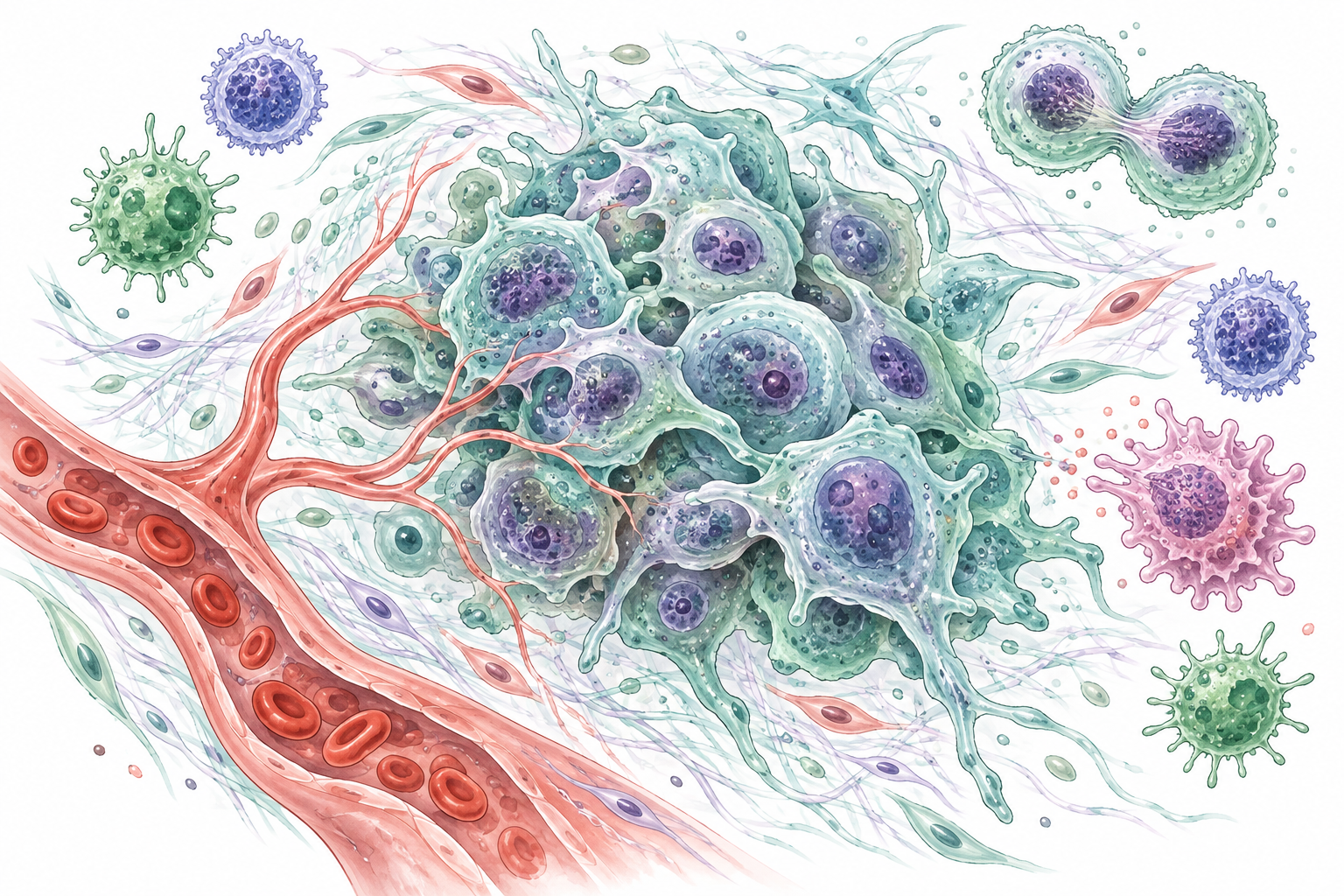
Cells, vessels and immunity: cancer develops within a microenvironment. Conceptual illustration, not to scale.
- Sustaining proliferative signaling
- Evading growth suppressors
- Resisting cell death
- Replicative immortality
- Inducing angiogenesis
- Invasion and metastasis
- Deregulating cellular energetics
- Avoiding immune destruction
- Genome instability and mutation
- Tumor-promoting inflammation
- Phenotypic plasticity
- Nonmutational epigenetic reprogramming
- Polymorphic microbiomes
- Senescent cells
A conceptual framework, not a diagnostic checklist. The importance of each feature varies across tumors and contexts.
Note: Information reflects 2025 standards. Verify clinical statuses and references periodically.
Skeptic's corner: The hallmarks framework is a useful heuristic, not a rigid law. Not all cancers exhibit all hallmarks, and the relative importance varies by cancer type and stage.
The Six Original Hallmarks (Hanahan & Weinberg, 2000)
1. Sustaining Proliferative Signaling
- Mechanism: Constitutive activation of growth pathways
- Key players: Growth factors, receptors, signaling cascades
- Examples: EGFR, HER2, RAS, PI3K Sources: [1]
- Therapeutic targets: Tyrosine kinase inhibitors, monoclonal antibodies
2. Evading Growth Suppressors
- Mechanism: Inactivation of tumor suppressor pathways
- Key players: RB, p53, APC, PTEN
- Examples: RB phosphorylation, p53 mutations
- Therapeutic targets: CDK4/6 inhibitors, p53 restoration
3. Resisting Cell Death
- Mechanism: Defective apoptosis and autophagy
- Key players: BCL-2 family, p53, caspases
- Examples: BCL-2 overexpression, p53 mutations
- Therapeutic targets: BCL-2 inhibitors, BH3 mimetics
4. Enabling Replicative Immortality
- Mechanism: Telomere maintenance and senescence bypass
- Key players: Telomerase, ALT, p16/pRB
- Examples: TERT activation, p16 inactivation
- Therapeutic targets: Telomerase inhibitors; senescence‑targeting strategies under investigation (senolytics/SASP)
5. Inducing Angiogenesis
- Mechanism: New blood vessel formation
- Key players: VEGF, FGF, PDGF, HIF-1α
- Examples: VEGF overexpression, hypoxia
- Therapeutic targets: Anti-angiogenic drugs, VEGF inhibitors
6. Activating Invasion and Metastasis
- Mechanism: Epithelial-mesenchymal transition (EMT)
- Key players: SNAIL, TWIST, ZEB1, MMPs
- Examples: E-cadherin loss, vimentin expression
- Therapeutic targets: EMT inhibitors, metastasis suppressors
Enabling Characteristics (2011)
Genomic Instability and Mutation
- Mechanism: Defective DNA repair and checkpoint control
- Key players: MMR, BER, NER, HR, NHEJ
- Examples: MSI, HRD, chromosomal instability
- Therapeutic targets: PARP inhibitors, DNA damage response inhibitors
Tumor-Promoting Inflammation
- Mechanism: Chronic inflammation and immune cell infiltration
- Key players: Cytokines, chemokines, immune cells
- Examples: IL-6, TNF-α, macrophages
- Therapeutic targets: Anti-inflammatory drugs, immune modulators
Emerging Hallmarks Added in 2011
Sources: [2]
7. Deregulating Cellular Energetics
- Mechanism: Metabolic reprogramming (Warburg effect) Sources: [4]
- Key players: Glucose transporters, glycolytic enzymes, mitochondria
- Examples: GLUT1 overexpression, PKM2 activation
- Therapeutic targets: Metabolic inhibitors, glycolysis blockers
8. Avoiding Immune Destruction
- Mechanism: Immune evasion and suppression
- Key players: PD-1, PD-L1, CTLA-4, Tregs
- Examples: Checkpoint expression, immune cell exclusion
- Therapeutic targets: Immune checkpoint inhibitors, CAR-T cells
New Dimensions Proposed in 2022
Sources: [3]
9. Unlocking Phenotypic Plasticity
- Mechanism: Cellular plasticity and transdifferentiation Sources: [5]
- Key players: Transcription factors, chromatin remodelers
- Examples: Lineage switching, drug resistance
- Therapeutic targets: Epigenetic drugs, differentiation therapy
10. Non-mutational Epigenetic Reprogramming
- Mechanism: Epigenetic changes without DNA mutations
- Key players: DNA methyltransferases, histone modifiers
- Examples: DNA methylation, histone modifications
- Therapeutic targets: Epigenetic drugs, chromatin modifiers
11. Polymorphic Microbiomes
- Mechanism: Tumor-associated microbiota Sources: [6]
- Key players: Bacteria, viruses, fungi
- Examples: Fusobacterium, HPV, EBV; fungal mycobiome in cancers Sources: [7]
- Therapeutic targets: Antibiotics, probiotics, vaccines
12. Senescent Cells
- Mechanism: Senescence-associated secretory phenotype (SASP) Sources: [8]
- Key players: Senescent cells, SASP factors
- Examples: p16 expression, cytokine secretion
- Therapeutic targets: Senolytics, SASP inhibitors
Laboratory Techniques
Hallmark Assessment
# Hallmark signature analysis (educational example; not validated clinically)
import pandas as pd
import numpy as np
from sklearn.preprocessing import StandardScaler

def calculate_hallmark_scores(gene_expression, hallmark_genes):
    """
    Calculate hallmark scores from gene expression data
    """
    scores = {}

    for hallmark, genes in hallmark_genes.items():
        # Get expression of hallmark genes
        hallmark_expr = gene_expression[genes].mean(axis=1)

        # Normalize scores
        scaler = StandardScaler()
        normalized_scores = scaler.fit_transform(hallmark_expr.values.reshape(-1, 1))

        scores[hallmark] = normalized_scores.flatten()

    return pd.DataFrame(scores, index=gene_expression.index)

# Example hallmark gene sets
hallmark_genes = {
    'Proliferative_Signaling': ['MYC', 'CCND1', 'CCNE1', 'CDK4', 'CDK6'],
    'Growth_Suppression': ['TP53', 'RB1', 'CDKN2A', 'PTEN', 'APC'],
    'Cell_Death': ['BCL2', 'BCL2L1', 'BAX', 'BAK1', 'CASP3'],
    'Immortality': ['TERT', 'TERC', 'CDKN2A', 'CDKN1A'],
    'Angiogenesis': ['VEGFA', 'VEGFB', 'VEGFC', 'FGF2', 'PDGFA'],
    'Metastasis': ['SNAI1', 'SNAI2', 'TWIST1', 'ZEB1', 'CDH1'],
    'Metabolism': ['GLUT1', 'PKM2', 'LDHA', 'HK2', 'PFKP'],
    # Toy list for expression demos, not a validated tumor-cell signature.
    # CTLA4 is primarily a T-cell/Treg checkpoint marker and is intentionally excluded.
    'Immune_Evasion': ['CD274', 'PDCD1LG2', 'LGALS9', 'HAVCR2']
}Functional Assays
- Proliferation: BrdU, Ki-67, EdU
- Apoptosis: Annexin V, TUNEL, caspase activity
- Angiogenesis: Tube formation, Matrigel assay
- Metastasis: Transwell, wound healing, xenograft
Clinical Relevance
Diagnostic Markers
- Proliferation: Ki-67, PCNA
- Apoptosis: BCL-2, BAX
- Angiogenesis: VEGF, CD31
- Metastasis: E-cadherin, vimentin
Therapeutic Targets
Traditional Hallmarks
- Proliferation: Tyrosine kinase inhibitors
- Growth suppression: CDK4/6 inhibitors
- Apoptosis: BCL-2 inhibitors
- Angiogenesis: VEGF inhibitors
- Metastasis: EMT inhibitors
New Hallmarks
- Metabolism: Glycolysis inhibitors
- Immune evasion: Checkpoint inhibitors
- Plasticity: Epigenetic drugs
- Microbiome: Antibiotics, probiotics
Research Applications
Drug Discovery
- Target identification: Hallmark-specific targets
- Biomarker development: Hallmark signatures
- Combination therapy: Multiple hallmark targeting
Precision Medicine
- Molecular profiling: Hallmark assessment
- Targeted therapy: Hallmark-guided treatment
- Resistance mechanisms: Hallmark switching
Practical Considerations
Sample Requirements
- Tumor tissue: Fresh or FFPE
- Normal tissue: Comparison samples
- Multiple time points: Treatment response
Data Analysis
- Gene expression: RNA-seq, microarrays
- Protein expression: IHC, Western blot
- Functional assays: Cell-based models
FAQ
Q: Do all cancers exhibit all hallmarks? A: No, the relative importance of each hallmark varies by cancer type and stage.
Q: Can we target multiple hallmarks simultaneously? A: Yes, combination therapy targeting multiple hallmarks is often more effective.
Q: How do the new hallmarks change treatment strategies? A: They provide new therapeutic targets and explain resistance mechanisms.
References (APA Style)
Hanahan, D., & Weinberg, R. A. (2000). The hallmarks of cancer. Cell, 100(1), 57-70.
Hanahan, D., & Weinberg, R. A. (2011). Hallmarks of cancer: The next generation. Cell, 144(5), 646-674.
Hanahan, D. (2022). Hallmarks of cancer: New dimensions. Cancer Discovery, 12(1), 31-46.
References
- Hanahan & Weinberg 2000 — Cell 100(1):57-70. doi:10.1016/S0092-8674(0081683-9.
- Hanahan & Weinberg 2011 — Cell 144(5):646–674. doi:10.1016/j.cell.2011.02.013.
- Hanahan 2022 — Cancer Discovery 12(1):31–46. doi:10.1158/2159-8290.CD-21-1059.
- Metabolic reprogramming and Warburg effect in cancer metabolism reviews (see fundamentals/cancer‑metabolism‑warburg.md and primary reviews).
- Gupta GP & Massague J. Cancer metastasis: building a framework. Cell. 2006;127(4):679-695. doi:10.1016/j.cell.2006.11.001.
- Sepich-Poore GD, Zitvogel L, Straussman R, Hasty J, Wargo JA, Knight R. The microbiome and human cancer. Science. 2021;371(6536):eabc4552. doi:10.1126/science.abc4552.
- Pan‑cancer mycobiome analyses highlighting fungi in cancers (Nature 2023/2024).
- Schmitt CA, Wang B, Demaria M. Senescence and cancer: role and therapeutic opportunities. Nat Rev Clin Oncol. 2022;19:619-636. doi:10.1038/s41571-022-00668-4.